
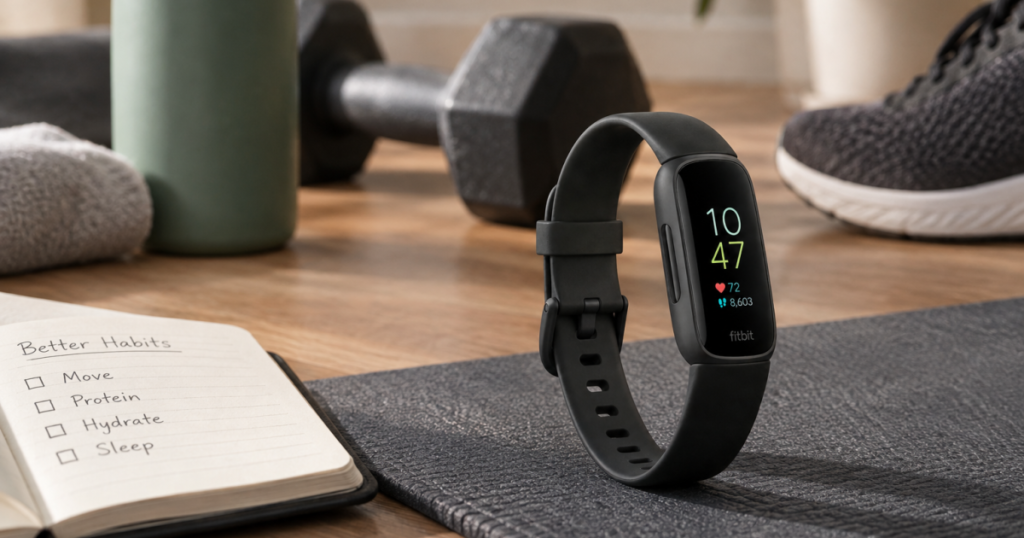
A tracker is at its best when it makes the boring parts of progress easier to repeat. This Fitbit Inspire 3 review treats the Google Fitbit Inspire 3 as a body-recomposition support tool: useful for movement, exercise, heart-rate and sleep trends, but not a device that measures fat loss or muscle gain directly.
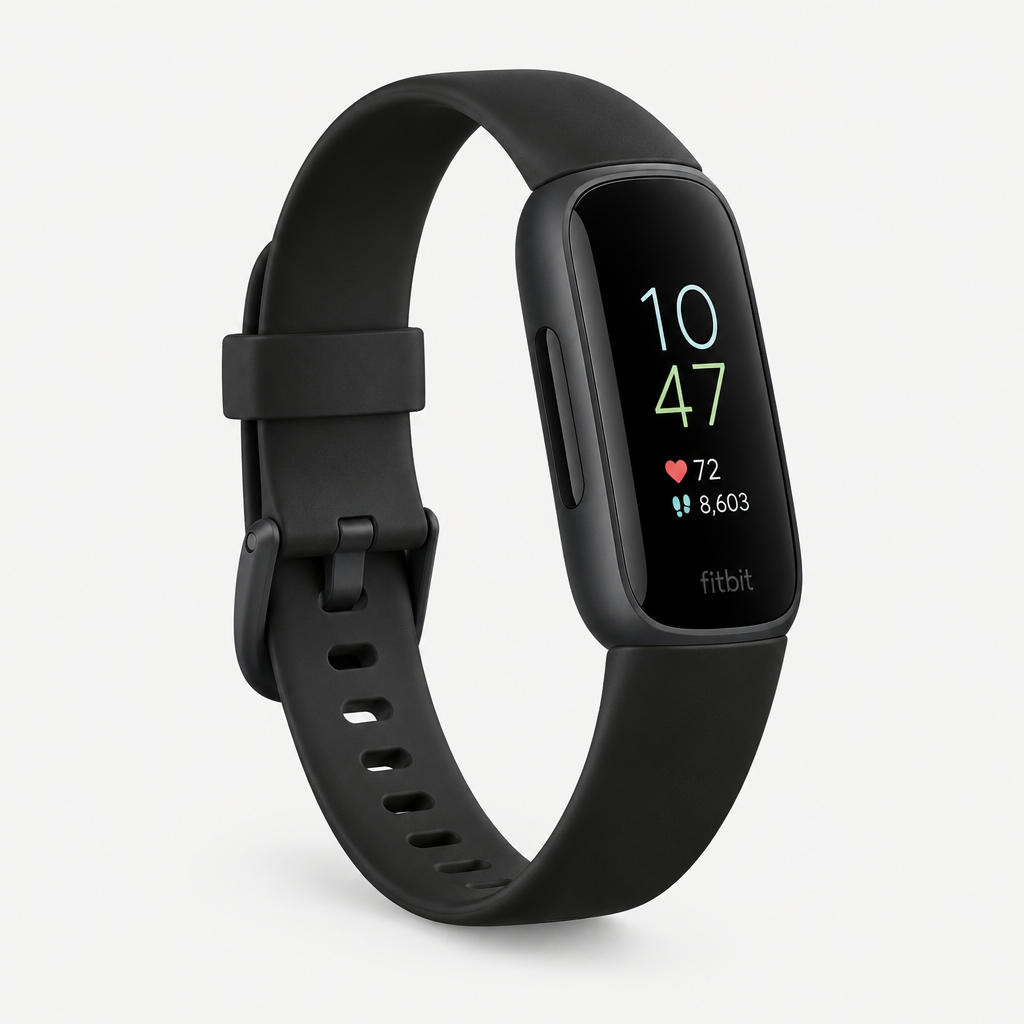
Fitbit by Google Google Fitbit Inspire 3
Best for readers who need gentle activity feedback, sleep trends, and walking consistency without pretending to measure recomposition directly
Fitbit by Google positions the Google Fitbit Inspire 3 as a wrist-worn health and fitness tracker. The important ownership detail is that it is not fully independent: setup and syncing require the Google Health app on a compatible phone running Apple iOS 16.4 or higher or Android OS 11.0 or higher, with Bluetooth LE and an internet connection.
Health diagnosis or treatment decisions based on heart-rate, SpO2, temperature, or sleep concerns should be handled by a qualified healthcare professional in line with applicable clinical standards and local requirements.
Pros & Cons
Pros
- Compact 1.55 x 0.73 x 0.46 in tracker suits low-profile daily wear.
- Very light at 0.039 lb, which supports all-day tracking comfort.
- Useful sensor mix for activity, heart-rate, SpO2, temperature, and light-based tracking context.
- $99.95 list price keeps it approachable for a recomposition habit tracker.
Cons
- Connected GPS needs a phone for pace and distance during jogs, hikes, or bike rides.
- It does not directly measure body fat, lean mass, or recomposition outcomes.
- Setup and use depend on the Google Health app and a compatible iOS or Android phone.
Product Details
- Product: Google Fitbit Inspire 3 health and fitness tracker
- US list price: $99.95
- Included subscription trial: 3 months of Google Health Premium
- Tracker dimensions: 1.55 x 0.73 x 0.46 in
- Tracker weight: 0.039 lb
- Display: AMOLED display with Corning Gorilla Glass 3
- Charge time: 2 hours from 0 to 100 percent
- Water resistance: listed to 50 meters, about 164 ft
- Syncing: Bluetooth LE and internet connection required, with syncing range up to 30 ft
The real value is routine feedback, not body-composition proof
For recomposition, the Google Fitbit Inspire 3 is most useful when you treat it as a behavior mirror. It can help you notice whether you are walking regularly, whether exercise sessions are showing up in your week, and whether your sleep patterns are drifting. Those are not cosmetic outcomes, but they are the kind of repeatable inputs that make body change more likely to become sustainable.
The myth to avoid is the idea that a wrist tracker can settle whether you are losing fat and gaining muscle. The Google Fitbit Inspire 3 tracks activity and wellness metrics; it does not directly measure body fat, lean mass, or recomposition outcomes. That distinction matters because recomposition often looks messy on the scale, and a tracker can either calm the process or make it noisier depending on how you use it.
If you are starting from scratch, pair the tracker with a simple practice structure rather than a dramatic transformation plan. A useful example is two strength days and regular walking, where the tracker’s job is to make walking and consistency more visible, not to judge your body every morning.
Activity tracking works best when the phone dependency fits your life
The Google Fitbit Inspire 3 can support pace and distance mapping for jogs, hikes, or bike rides through connected GPS, but that requires your phone. That is a meaningful buying factor. If you usually walk with your phone in your pocket anyway, the compromise may feel minor. If you want to leave your phone at home and still map outdoor pace and distance, this is the wrong kind of tracker for that particular job.
The same practical lens applies to syncing. The device requires Bluetooth LE and an internet connection, and Google lists syncing range up to 30 ft. In normal ownership terms, this means the tracker is part of a phone-and-app workflow. It is a wrist device, but your actual record-keeping lives in the app environment.
Smartphone notifications are also tied to phone compatibility, with Android 11 or higher noted for some notification behavior. That is not a problem if you are buying the Google Fitbit Inspire 3 mainly for activity and sleep trends, but it is a reminder that the device’s usefulness is partly shaped by the phone you already use.
Comfort and durability are the quiet strengths
The tracker’s 1.55 x 0.73 x 0.46 in body and 0.039 lb weight are important because adherence is physical before it is motivational. A tracker that feels easy to keep on has a better chance of collecting ordinary-day data: the lunch walk, the short evening loop, the lifting session you nearly skipped, the sleep pattern after a stressful week.
The AMOLED display with Corning Gorilla Glass 3 gives the Google Fitbit Inspire 3 a modern display-and-glass package without turning it into a bulky watch. The water resistance rating, listed to 50 meters, about 164 ft, is another practical point for everyday use. Google also recommends drying the band after it gets wet for skin comfort, which is the sort of small maintenance habit that matters more than glossy product photos suggest.
Operating conditions also have boundaries: Google lists an operating temperature of 32° to 104°F and a maximum operating altitude of 28,000 ft. Most readers will never need to think about the altitude number, but the temperature range is useful context if you leave gear in hot cars, cold bags, or outdoor settings.
Battery expectations should match the features you turn on
Google’s official battery framing includes an up-to-10-days baseline, but the important caveat is that use, settings, and other factors change that number. Always-on display can reduce official battery life to up to 3 days, and SpO2 monitoring requires more frequent charging. The device charges from 0 to 100 percent in 2 hours.
That makes the Google Fitbit Inspire 3 a good fit for someone who wants low-friction tracking but does not want another device that demands constant attention. The trade-off is simple: the more advanced or always-visible features you use, the more often you will think about charging. For many recomposition-focused readers, that is a fair exchange if the tracker helps keep walking, workouts, and sleep awareness in view.
Data without panic is the ownership skill
The Google Fitbit Inspire 3 gives you more signals than a notebook, but more signals do not automatically mean better decisions. Steps can be motivating. Heart-rate trends can add context. Sleep information can nudge recovery awareness. None of those should become a daily referendum on whether your body is “working.”
A healthier pattern is to combine the tracker with slower, steadier progress checks: workout performance, clothing fit, body weight trends, occasional measurements, and how consistently you are repeating the basics. If numbers tend to pull you into overanalysis, use a low-stress body recomposition tracking routine so the device becomes one input among several, not the loudest voice in the room.
The included 3 months of Google Health Premium may add value for readers who like app-based coaching or deeper wellness views, but it should be judged separately from the hardware. The tracker’s core appeal is still its ability to make repeatable behaviors more visible. A subscription trial is a bonus, not the reason to buy a wrist tracker for recomposition.
The buying decision
The Google Fitbit Inspire 3 makes the most sense for someone who wants a low-profile activity and wellness tracker for steps, heart rate, exercise, sleep, and general trends. It is not trying to be a full training plan, a body-composition scale, or a direct measure of muscle gain. That restraint is part of why it fits this site’s view of progress: good tools support repeatable behavior; they do not promise a new body on command.
It is less compelling if your priority is phone-free GPS mapping, direct body-composition measurement, or a tracker that works independently of a compatible phone and app. Those are not small footnotes. They shape the ownership experience from day one.
Verdict
Score: 8.5/10.
The Google Fitbit Inspire 3 earns its place as a practical recomposition support tool because it is compact, light, reasonably priced at $99.95, and focused on the behavior signals that often matter most: activity, exercise, heart-rate context, and sleep trends. The score is held back by its phone-dependent GPS, app-and-phone requirements, and the fact that it cannot directly measure body fat or lean mass. Used with realistic expectations, it is a smart buy for consistency; used as proof of recomposition, it asks the wrong question.
Fitbit by Google Google Fitbit Inspire 3
Best for readers who need gentle activity feedback, sleep trends, and walking consistency without pretending to measure recomposition directly
You might also like: Two, Three, or Four Lifting Days for Body Recomposition?.