
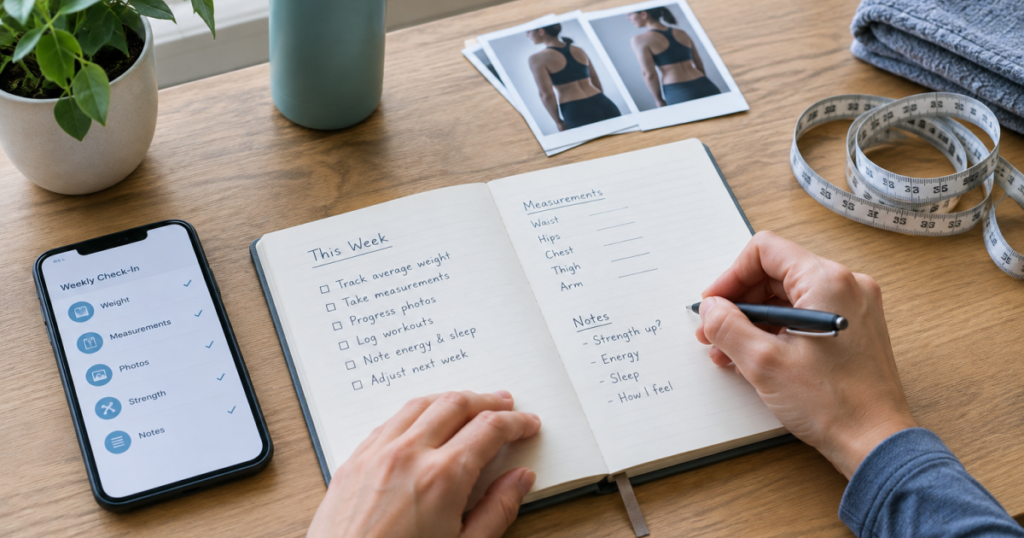
The goal of body recomposition tracking is not to interrogate your body every morning. It is to collect enough repeatable evidence to notice fat loss, muscle gain, strength changes, and habit consistency without turning every weigh-in into a referendum on your future. A good routine feels almost boring, which is exactly why it works.
Medical evaluation, diagnosis, and treatment decisions related to rapid weight change, disordered eating concerns, dizziness, or pain should be handled by a qualified healthcare professional in line with applicable local standards of care.
The big picture
The lowest-stress way to track recomposition progress is to use a small dashboard: a weekly body-weight average, a waist measurement every two to four weeks, monthly progress photos, and a simple strength log. Each metric gets a job. The scale shows trend direction, the tape measure adds shape context, photos reveal visual change over time, and the training log shows whether your body is becoming more capable.
The trick is not to find the perfect metric. It is to stop asking one metric to answer every question. A single weigh-in cannot tell you whether you gained muscle, retained water, ate a saltier dinner, slept poorly, or simply caught your body on a noisy morning. A tracking routine should reduce the number of arguments you have with your own data.
- Daily or fixed-day weigh-ins: optional, used only to calculate a weekly average.
- Weekly review: compare the average, not the loudest single number.
- Every two to four weeks: measure waist at the same spot, under the same conditions, in inches.
- Monthly: take photos in similar lighting, posture, clothing, and distance from the camera.
- Every workout: log exercises, sets, reps, and how hard the work felt.
Step 1: Choose four signals and ignore the rest
More tracking does not automatically mean better insight. It often means more opportunities to overreact. Start with four signals that answer different questions.
1. Weight trend
Scale weight is useful when it is treated as a trend, not a mood ring. Your body weight can swing from water, digestion, menstrual cycle changes, sodium, carbohydrate intake, soreness, travel, and sleep. That does not make weighing useless. It makes single weigh-ins weak evidence.
If weighing feels manageable, use a consistent routine: after waking, after using the bathroom, before eating or drinking, and with similar clothing. Then compare weekly averages. If daily weighing makes you edgy, use three fixed mornings per week or a once-weekly check-in. The method matters less than whether you can repeat it without spiraling. For a deeper look at the habit itself, see self-monitoring and regular weighing.
2. Waist measurement

A waist measurement can add context when the scale barely moves. Use the same tape, same location, same posture, and same time of day. Measure in inches, write it down, and resist the urge to repeat it five times until you get a number you like. That is not tracking; that is bargaining.
3. Progress photos

Photos are most helpful when they are standardized. Use the same mirror or camera position, lighting, clothing style, and relaxed posture. Front, side, and back photos once per month are usually enough for a low-stress routine. Weekly photos can work for some people, but they can also turn into microscopic self-auditing.
4. Strength log
A recomposition routine without training data is missing an important part of the story. If your reps, loads, control, or exercise confidence are improving, that matters even when the scale is being stubborn. Log enough to know what you did and what you can reasonably try next time.
Step 2: Set a check-in cadence before emotions set it for you
The time to decide how often you will check progress is before a strange weigh-in tests your patience. A clear cadence keeps you from creating new rules every time the data feels inconvenient.
- Daily action: follow the plan for meals, walking, training, sleep support, or recovery as realistically as possible.
- Workout action: record what you lifted or completed, plus one note about effort or form.
- Weekly action: calculate your average weight and review training consistency.
- Monthly action: compare photos, waist measurement, and strength trends together.
This rhythm gives you frequent enough feedback to stay engaged, but not so much feedback that every morning becomes a courtroom drama. Most recomposition changes need time to become visible. The routine should keep you steady while the evidence accumulates.
Step 3: Use a simple dashboard
A dashboard can be a notebook page, spreadsheet, notes app, or printed sheet. The format is not the magic. The restraint is.
- Week of: write the date range.
- Average weight: use the average of your available weigh-ins.
- Waist: update only on measurement weeks.
- Strength marker: pick two to four repeatable exercises, such as a squat pattern, hinge, push, and pull.
- Walking or activity: record days completed, not perfection.
- Protein structure: note how many days included a clear protein source at most meals.
- Sleep or recovery note: one short phrase, such as “short sleep” or “felt recovered.”
- Decision for next week: repeat, adjust, or simplify.
The final line is the most important. Tracking should lead to a decision, not just a pile of numbers. If the data does not change what you do, you may not need to collect it.
Step 4: Read combinations, not isolated numbers
Body recomposition is frustrating when you expect every signal to move in the same direction at the same time. They rarely do. The useful question is, “What pattern is forming?” not “What did one number say today?”
- Weight stable, waist down, strength up: often a promising recomposition pattern. Keep going and avoid making the plan harsher just because the scale is quiet.
- Weight down, strength falling, energy low: the plan may be too aggressive or recovery may be lagging. Look at sleep, food structure, and training load.
- Weight up, waist stable, strength up: this may reflect training adaptation, water, food volume, or muscle gain. Watch the trend for several weeks before changing course.
- Weight up, waist up, consistency low: do not panic, but do get honest. Return to the smallest repeatable habits before chasing a dramatic reset.
- Photos improving, measurements mixed: standardize the measurement process before assuming the photos are lying.
If the scale barely moves but other signals are changing, that is not automatically failure. It may be exactly the situation described in what can change when your body weight barely moves.
Step 5: Tie tracking to controllable behaviors
Progress data is more useful when it points back to behaviors you can actually repeat. You cannot directly command fat loss or muscle gain on a Tuesday. You can decide whether to train, walk, build meals around protein-rich foods, and sleep like recovery is part of the plan rather than an optional luxury.
For training, the central question is whether your routine gives your muscles a reason to adapt. That does not mean maxing out or turning every set into a heroic documentary scene. It means practicing movements, gradually increasing challenge when appropriate, and keeping enough consistency to see whether the approach is working. The progressive resistance training method page is a useful next stop if your log shows you are repeating workouts but not progressing them.
For nutrition, avoid turning every meal into arithmetic unless that level of tracking genuinely helps you. A low-stress approach might be as simple as anchoring meals with a clear protein source, adding high-fiber foods, keeping portions consistent, and noticing whether hunger, energy, and training are manageable. Some readers like detailed food logs. Others do better with meal templates. The right system is the one you can use honestly without it taking over the day.
Straight answers
Should I weigh myself every day?
Only if it lowers confusion rather than raising stress. Daily weighing can be useful when you focus on weekly averages. If daily numbers affect your mood or behavior too strongly, use fixed-day weigh-ins or rely more on monthly measurements, photos, and training logs.
How often should I take progress photos?
Monthly is enough for most low-stress tracking routines. Use consistent lighting, distance, posture, and clothing. The goal is comparison, not a daily inspection ritual.
What if my measurements are inconsistent?
Standardize the process before interpreting the result. Use the same tape, measure at the same location, stand relaxed, and record in inches. If two readings differ, take a third and use the most repeatable number rather than chasing the smallest one.
When should I change my plan?
Change the plan when several signals point in the same direction for a few weeks, not because one weigh-in annoyed you. If consistency has been poor, fix the routine first. If consistency has been solid and all signals are stalled, adjust one variable at a time.
What to remember
A calm tracking routine protects you from two common traps: ignoring all feedback until frustration builds, and checking so often that normal fluctuations feel like failure. The sweet spot is structured but not obsessive.
Use the scale for trends, the tape for shape context, photos for visual comparison, and the training log for capability. Review them together on a schedule you can live with. Recomposition is already slow enough without letting every data point pull the steering wheel.